

Google Stadia was never going to work
Google Stadia was never going to work

Google Stadia hit a major roadblock this week, when Google announced that it had ceased all first-political party game development for its innovative cloud gaming service. The company shut down non ane, simply 2 development studios, and bid goodbye to Jade Raymond, the visionary producer who greenlit Assassin's Creed. Google claims that Stadia will be focusing on forging strong partnerships with third-party studios from now on.
In other words: Stadia just lost its biggest adventure to stand apart from the rest of the gaming pack. For a service that always struggled to forge an identity of its own, it's a tremendous accident. While information technology'south not quite dead notwithstanding, it's reasonable to wonder if Stadia will however be effectually in a few years.
- Play the best PS5 games
- Also check out the all-time Xbox Series X games
- Super Basin 2021 live stream: How to sentry it online for free
Without any exclusive games, there'south substantially zip to set Google Stadia apart from the PC, PS5 or Xbox Series X — salvage for its cost of entry. Stadia's saving grace has always been its ability to play games on platforms you already own, obviating the need for a $500 console, or an even more expensive PC.
The question is whether at that place'south a huge audition of people who demand that feature. In my original Google Stadia review, I argued that at that place might non be. And unless that audience is prepared to emerge in droves within the next few years, it's possible that Google Stadia was — and is — simply a solution in search of a problem.
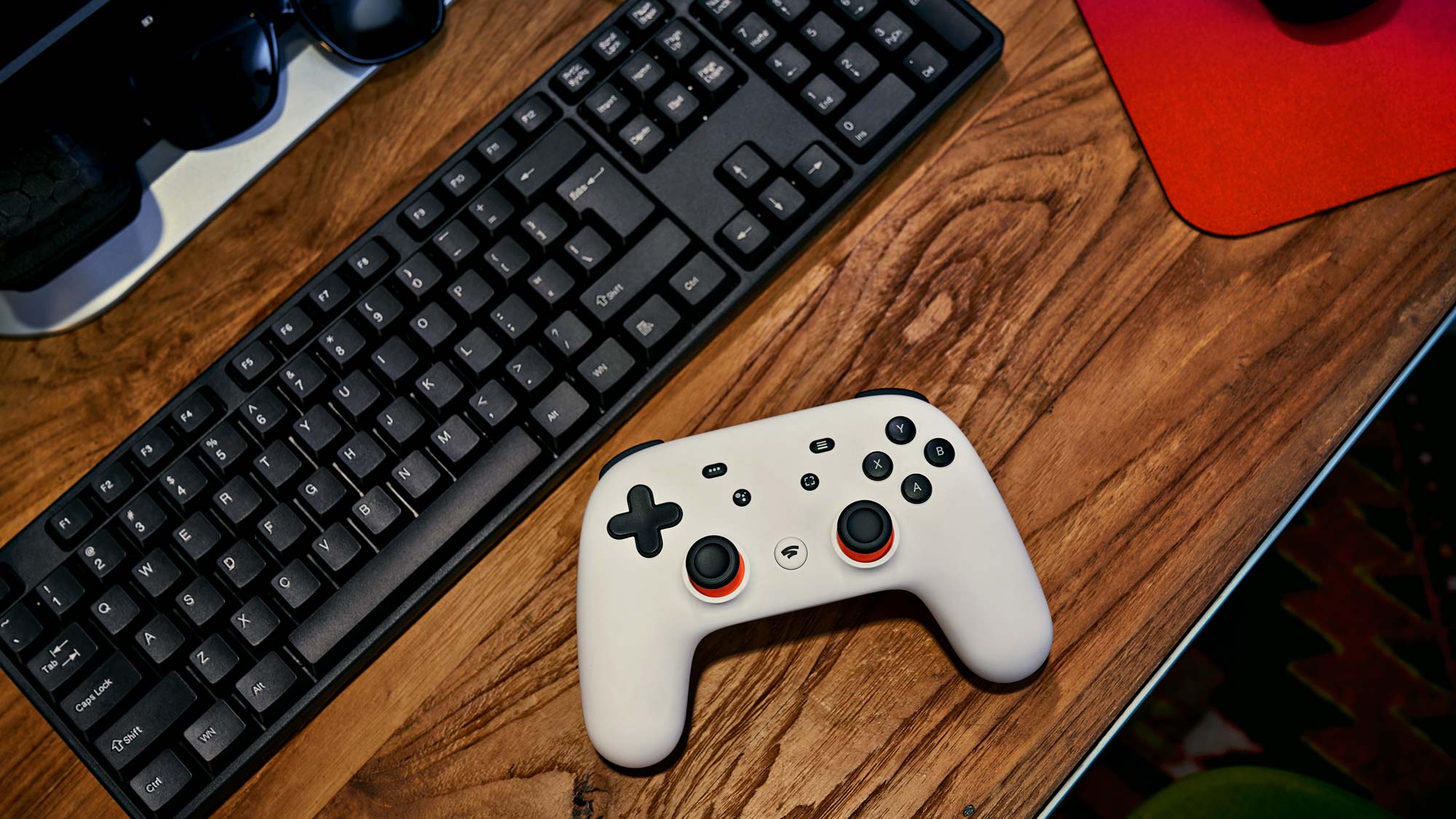
"Who is this for?"
Between mice, keyboards, headsets, monitors, desktops, laptops, games, streaming services and Web browsers, I write a lot of reviews. And every time I sit down to write ane, no matter what kind of product is information technology, my outset question is always the aforementioned: "Who is this for?"
More so than specs, or toll, or features, the unmarried most important matter about whatever production is its intended audience. If an extremely flawed product could prove useful to its potential audience, information technology is, on some level, yet worth because. If a nearly perfect production doesn't offer whatsoever item benefit to its potential audience, it's probably safe to ignore it.
While I admire a lot about Google Stadia, I've never been able to answer "Who is this for?" satisfactorily. From my original review:
"My biggest takeaway from my Google Stadia review, though, is that I just don't understand who needs it … [It'south] appealing to think that aspiring gamers tin now leap into big-budget mainstream titles without having to drib $300 on a console similar the PS4 Pro or Xbox I X, or much more than that on one of the all-time gaming PCs. But is there really a huge audition that's been waiting breathlessly all these years to play Destiny, or Tomb Raider, or Just Dance, just is also unwilling to buy a gaming platform?"
History has more than or less borne me out on that ane. While Google has been extremely cagey virtually exact sales figures, we do know that about a million people downloaded the app as of last April. By itself, that'southward a large number, and no doubt Stadia has grown since then. But consider that the PS5 has sold more than than 4 times as many units in less fourth dimension — and the PS5 costs at least $400, whereas the Stadia app is free. (The Xbox Series X is plain not far behind, so this is not a Sony-specific phenomenon.)
Stadia's library mostly comprises "core" games. These are often big, lavishly produced adventures that take dozens of hours to complete, such as Assassin'due south Creed Valhalla, Terminal Fantasy XV, Shadow of the Tomb Raider, Mortal Kombat eleven, Sekiro: Shadows Die Twice, Jedi: Fallen Lodge and then along. By and large speaking, you need a console or PC to run these games, dissimilar simpler fare, which works fine on a cell telephone.
Just given the selection between paying $500 for a make-new console and simply buying games à la card and streaming them, gamers seem to be going for the onetime choice by a factor of at to the lowest degree fourfold.
Proving this point beyond a shadow of a dubiety would require more data than we take access to. Just the common-sense conclusion is that Stadia's games cater to an audience that, generally, does not require Stadia's services. If you're the kind of gamer who wants to play Doom, or Spotter Dogs 2, or Octopath Traveler, you probably already own a organization that can do the aforementioned thing.
Stadia's shrinking benefits
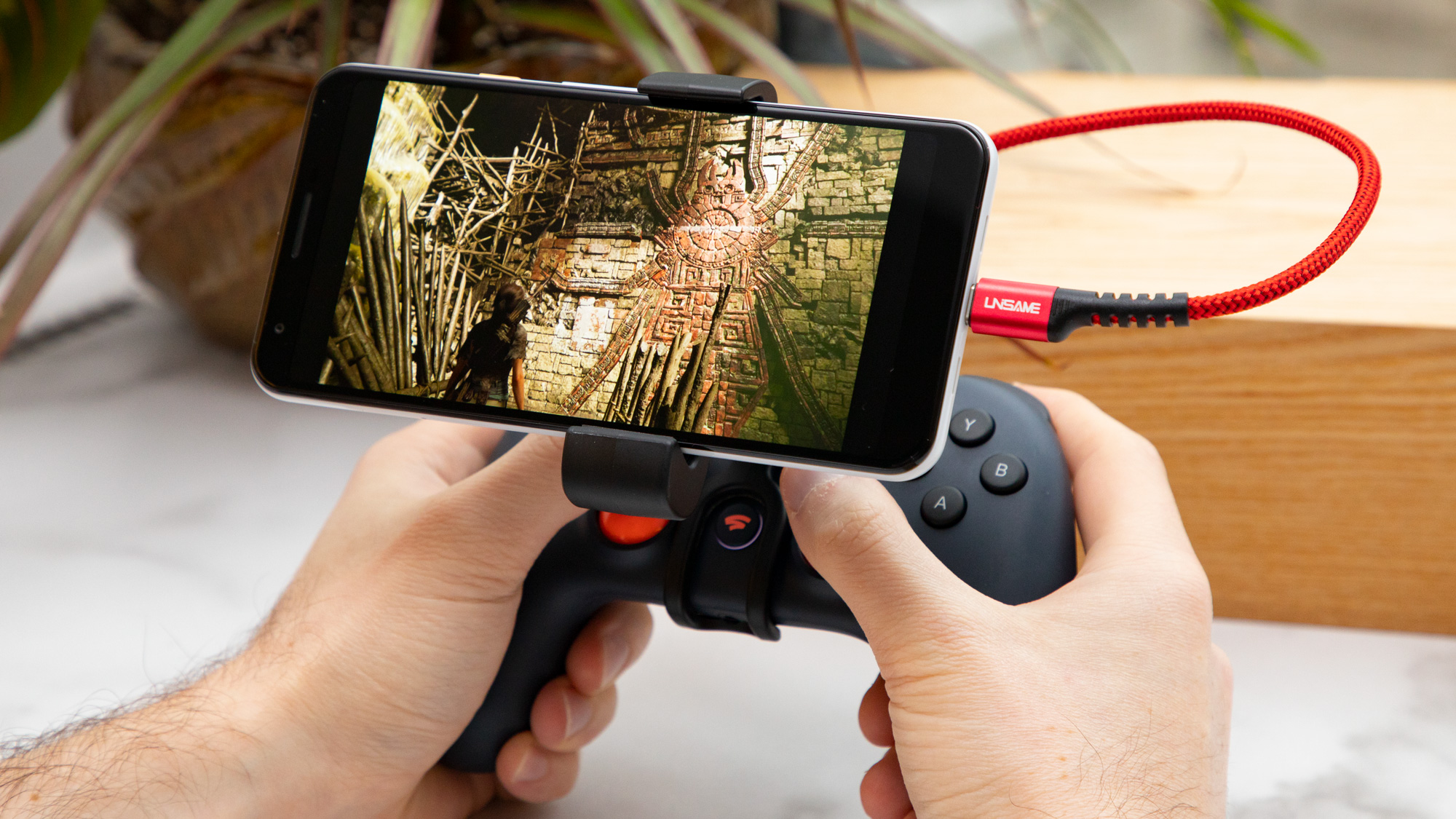
Granted, Google Stadia offers a few features that consoles and PCs can't match — or at least it did when information technology first launched. If you purchase a game on Stadia, it's doesn't have to live on a big black box in your living room. You tin can play your game on a PC; you lot tin play it on a TV; yous tin can play information technology on a smartphone; you can even play it on a Mac — a feature that, past itself, nearly justifies Google's whole experiment.
Only while these ideas were about revolutionary in 2019, they're get a lot more than commonplace since then. Services like Nvidia GeForce Now and Cloud Gaming (Beta) with Xbox Game Pass (which needs a catchier name, posthaste) likewise let you stream games to whatever computer, and most smartphones.
The big departure — and the reason why GeForce Now and Xbox Cloud Gaming are by and large ameliorate than Stadia — is that Nvidia and Microsoft'due south services allow you lot fully leverage the hardware yous already own. If you have an Xbox or a PC, you tin download a game and run information technology in real-time, or even offline, if you adopt. If you prefer to utilise a different platform, y'all tin stream it.
By offering core games, but locking players into a streaming delivery system, Stadia essentially bypasses powerful tech that its audition already owns. This ignores the fact that gamers ofttimes feel attached to their gear, be information technology the familiarity of a console, or the hard work that went into building a PC.
More chiefly, it also puts your feel entirely in Google's hands. If Stadia'south servers don't play squeamish — and sometimes they don't — you lot have no choice but to expect it out, fifty-fifty if you're playing a single-actor game. If the game drops a few frames now and then, or doesn't return background textures properly, or syncs sound improperly, it'due south a worse experience than merely using the console or PC y'all (probably) already own.

A familiar selection
Still, if Stadia had a rich host of sectional titles, these problems wouldn't really matter. Gamers had no effect buying the Nintendo Switch to play Breath of the Wild, or the PS5 to play Demon'southward Souls; they'd have fifty-fifty less of a problem ownership an exciting exclusive on Stadia, since there'south no associated hardware cost. (There's a $10-per-calendar month subscription if you want to play in 4K, but that's still a long way from $300-500 for a whole new panel.)
Despite being on the marketplace for more than a year, Stadia has very few exclusive titles: Gylt, Crayta, and Orcs Must Die iii. All iii games were decent, but non what you'd call "organisation-sellers." Apart from that, they all seemed like they'd play just fine on a PC or console; in that location'southward nothing distinctively "Stadia" about them. At present that Stadia'due south offset-party prospects are essentially nada, a breakout exclusive hit seems like an even more than remote prospect.
That brings the states back to the proverbial millstone around Stadia'southward neck: It is, and always has been, a service that sells games to people who already take amend means to play those games. I'm not denying that at that place's a real gear-restricted audience that's benefited. But all indications suggest that this audience is very minor, while traditional gaming systems are merely as popular every bit e'er.
To leave you with a physical case, Cyberpunk 2077 was probably as close as Stadia has come up to a breakout hit. While Cyberpunk 2077 is available on the PS4, PS5, Xbox 1 and Xbox Series X, it works (somewhat) properly but on PC — and simply very high-end PCs at that. And Stadia essentially gives users a high-cease PC for the price of a single game.
But as veteran producer Jacob Novik pointed out, in one case it'due south patched, Cyberpunk 2077 will be (almost) as good on most other platforms, putting Stadia right dorsum where information technology was to start. Given the choice betwixt something familiar that works well, and something new that works well-nigh besides, people volition usually go for the former.

Source: https://www.tomsguide.com/news/google-stadia-never-work
Posted by: ellispowee1981.blogspot.com
0 Response to "Google Stadia was never going to work"
Post a Comment